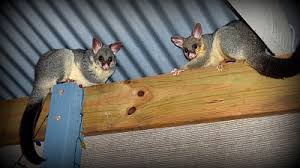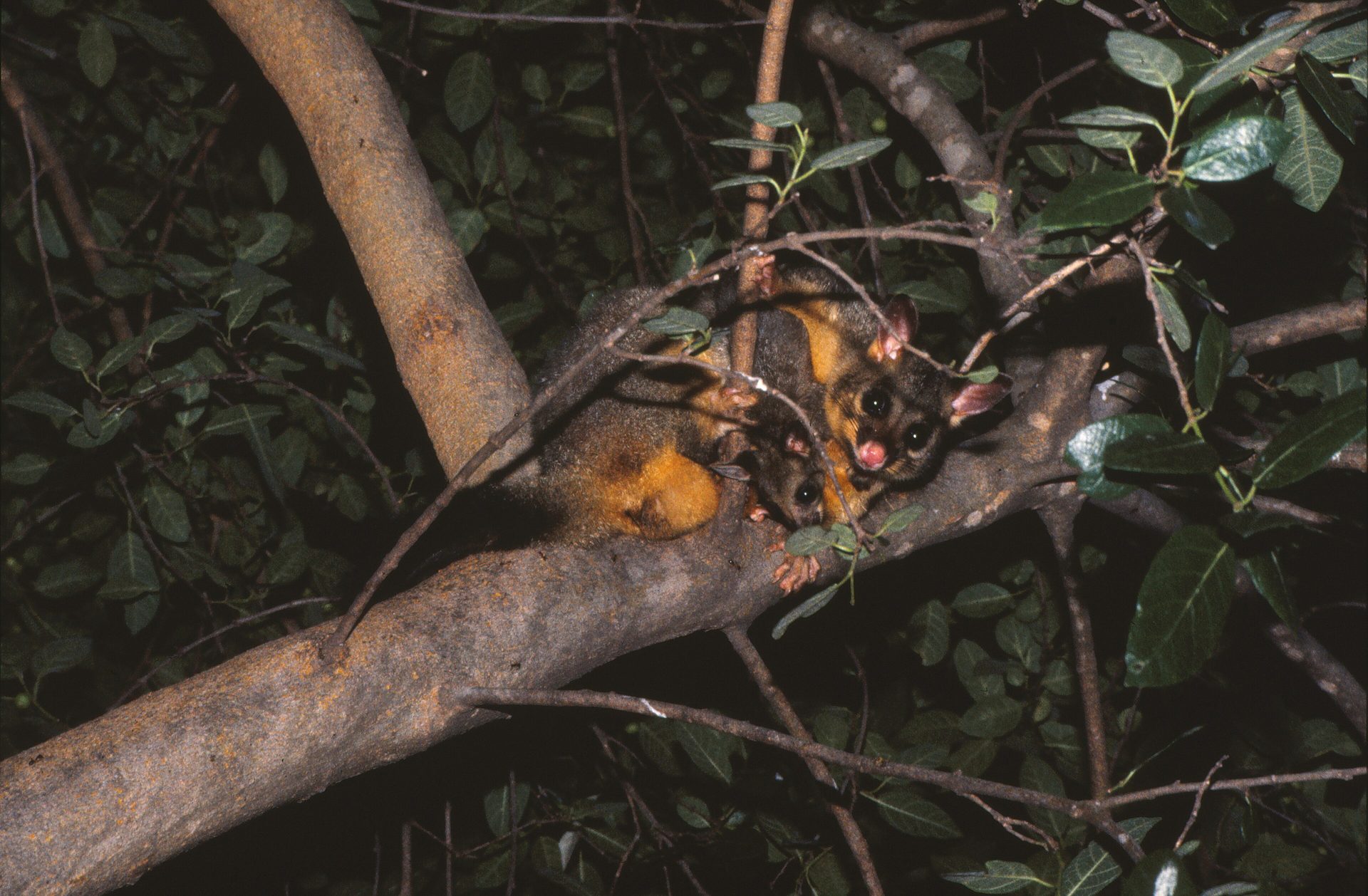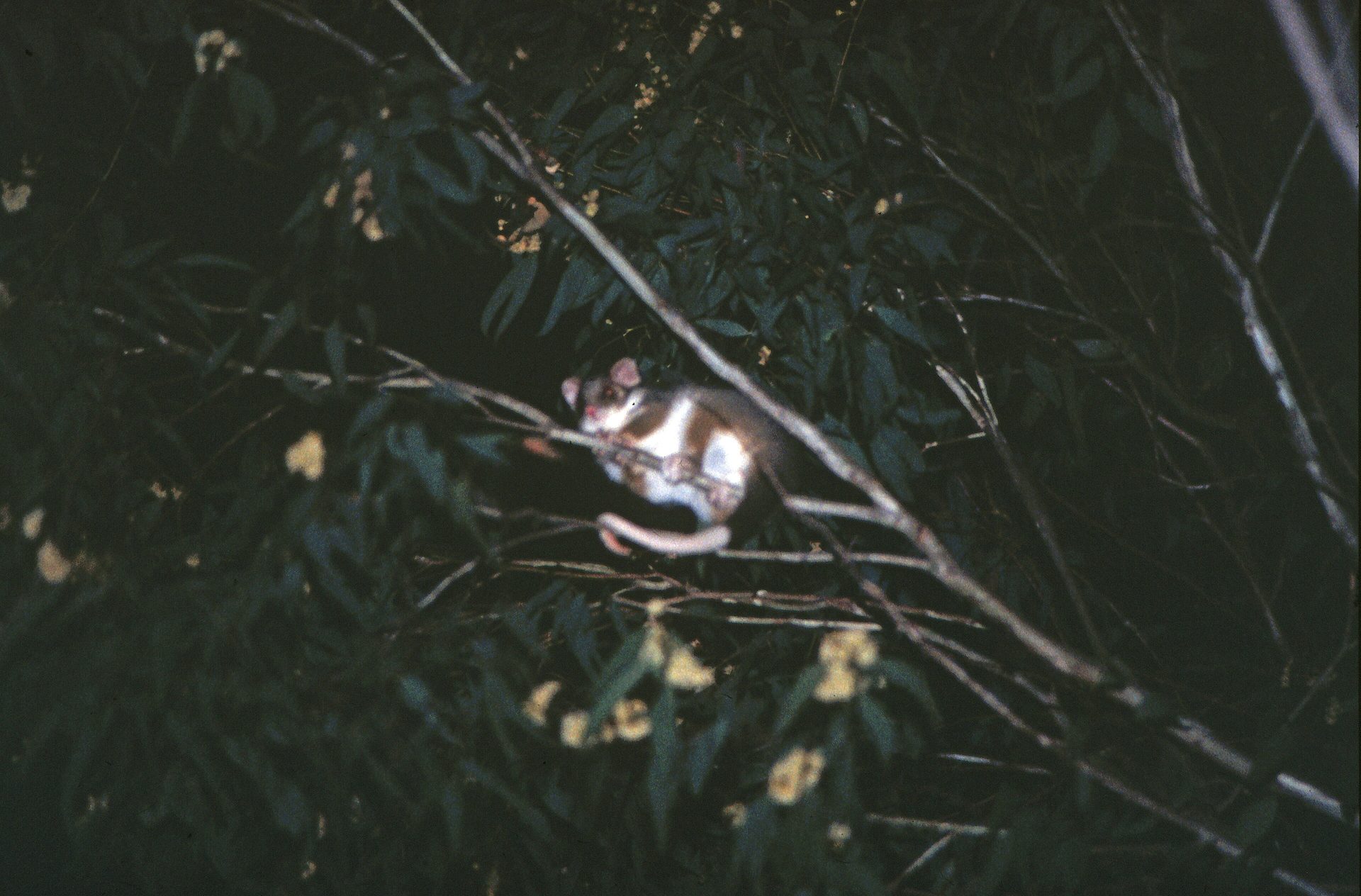
Two possum species account for nearly every residential callout in urban Australia: the common brushtail and the common ringtail. They look superficially similar in a torch beam at midnight, which is why identification usually happens from evidence rather than from a sighting.
The distinction matters for practical reasons. The species predicts where the animal is denning, what the entry point looks like, how many young are likely to be involved, and how the exclusion is staged. Get it wrong and you seal the wrong opening.
The two species, side by side
| Signal | Brushtail | Ringtail |
|---|---|---|
| Weight | 1.5–4kg, cat-sized | 0.7–1.1kg |
| Body length | 35–55cm | 30–35cm |
| Tail | Thick, bushy, dark, often black | Thin, tapering, white tip, tightly curled at rest |
| Ears | Long, pointed, prominent | Short, rounded, less obvious |
| Fur | Silver-grey to dark brown, coarse | Grey with rusty or reddish tinges, softer |
| Den | Tree hollows and roof cavities | Woven nest (drey) in dense shrubs |
| Young | Usually one | Commonly twins |
| Social structure | Solitary and territorial | Family groups |
| Voice | Loud guttural hissing, coughing, growling | Soft twittering and chittering |
| In roofs | Very common | Uncommon |
Work down that table with whatever evidence you have and the answer usually falls out in under a minute.
Size and weight — what you hear through the ceiling
Weight is the first thing you notice, because you hear it before you see anything.
A brushtail at three kilograms walking across ceiling joists sounds like a small cat has got into the roof. Individual footfalls are distinguishable. When it drops from a rafter onto the plaster, the whole ceiling registers it, and people describe it as somebody dropping a shoe upstairs.
A ringtail at under a kilogram is audible but much lighter — closer to a scampering sound than a thump. It is still heavier and slower than a rat, and it still travels in a purposeful straight line rather than the darting, doubling-back movement of a rodent.
If the noise wakes you from another room, you are almost certainly dealing with a brushtail.
The tail is the identifier
If you do get a look at the animal, ignore the face and look at the tail. It is the single most reliable feature and it does not vary with age or condition.
A brushtail has a thick, bushy tail, dark for most of its length and often fully black. The underside of the last third is bare — that is the prehensile gripping surface — but the overall impression is of a substantial, furred tail roughly as thick as the animal's forearm.
A ringtail has a thin tail that tapers steadily to a point, with a distinct white tip on most animals. At rest it is held in a tight coil, which is where the name comes from. It looks more like a length of rope than a brush.
The ears back this up. Brushtail ears are long, oval and stand well clear of the head. Ringtail ears are short and rounded and sit close, giving the head a smoother outline.
Where each one actually lives
This is the reason a roof problem is nearly always a brushtail problem.
Brushtails are hollow-denning animals. In bushland they occupy hollows in mature eucalypts, and those hollows take a century or more to form. Urban development removed most of them. A roof cavity is a functionally perfect substitute: dark, dry, insulated, elevated, with a defensible entrance and no predators. A brushtail that finds one has no reason to leave.
Ringtails build their own accommodation. They weave a spherical nest — a drey — out of shredded bark, grass and leaves, usually in dense shrubs, tea-tree, lilly pilly or thick vine growth two to five metres off the ground. Because they can construct shelter anywhere, they have far less need for a building.
Where ringtails do turn up in structures, it tends to be the margins rather than the main roof cavity: wall cavities, garden sheds, under decking, in a subfloor, inside a dense hedge that has grown against the eaves, or in a carport ceiling. Those are the places to check if the evidence points to a ringtail.
The noise signature
Both species vocalise, and they sound nothing alike.
Brushtails are loud and unmistakable. The territorial call is a deep guttural hissing that people describe as a chainsaw, a cough, or something considerably larger than a possum. Two males disputing a roof cavity in autumn will produce a sustained argument at two in the morning that carries down the street.
Ringtails are quiet. The contact call is a soft, high twittering, more like a bird than a mammal, and it is easy to miss unless the animal is close.
Rodents do not vocalise in a way you will hear through a ceiling. Any actual call — as opposed to scratching, gnawing or scurrying — means a possum.
Droppings
Both leave droppings in the den and along travel routes, and they differ enough to be useful.
- Brushtail droppings are 15 to 25 millimetres long, cylindrical, dark brown to black, and often slightly curved. They accumulate in quantity under the main denning spot in the roof cavity.
- Ringtail droppings are smaller — around 10 millimetres — more rounded and pellet-like, and usually found in tighter clusters.
Diet changes the appearance of both. Possums feeding heavily on fruit produce softer, darker droppings; on eucalypt leaves they are drier and more fibrous. Size and shape are more reliable than colour.
Neither should be handled without gloves and a P2 mask, and neither should be dry-swept. Sweeping aerosolises whatever is in the material.
Breeding, and why it matters more for ringtails
Both species carry young in a pouch, but the numbers differ.
A brushtail normally produces a single young per litter. The joey stays in the pouch for roughly four to five months, then rides on the mother's back and dens with her for several more weeks before becoming independent.
A ringtail commonly produces twins, and occasionally three. Pouch life is around four months, followed by a period riding on the back or being left in the drey while the mother feeds. Male ringtails share care of the young, which is unusual among Australian marsupials and part of why they live in family groups.
The practical consequence is the same for both: if there is any chance dependent young are present, a one-way door cannot go on the entry point. Separating a mother from young that cannot follow her out kills the young inside the cavity and turns a possum job into a dead animal job. With ringtails there is simply more than one to account for.
Damage: which one causes more
Brushtails cause more damage, and it is mostly a function of mass and behaviour.
- Insulation. A three-kilogram animal denning in one spot for months crushes batts flat and reduces their thermal value permanently.
- Ceilings. Repeated urination in the same location soaks through plaster. The stain appears first, the sag follows, and by then the sheet needs replacing.
- Wiring. Possums are not committed gnawers the way rats are, but they will chew cable, and a brushtail moving through a cavity dislodges cable clips and downlight covers.
- Entry points. A brushtail forcing a lifted tile or a corroded valley iron enlarges the opening, which then admits water and rodents.
Ringtail damage is lighter. Where they occupy a wall cavity or shed, expect nesting material, droppings, urine staining and noise rather than structural loss. The exception is a ringtail nesting in an air-conditioning duct or a chimney flue, where the nest itself becomes the problem.
What changes about the removal
The method is the same in principle — exclusion, not trapping — but the details shift.
For a brushtail, the work centres on the roof cavity: locate the den, identify the main entry point and every secondary opening, fit a one-way door on the active point, seal everything else with steel mesh and metal, and put a nest box on a nearby tree so the animal has somewhere to go.
For a ringtail, the search area is wider and lower. Wall cavities, subfloors, sheds, decking and dense vegetation touching the building all need checking, and the openings are often smaller and easier to miss. Ringtails also need their vegetation corridor considered: overhanging branches within a couple of metres of the roof line are the access route, and trimming them back changes the outcome as much as the mesh does.
In both cases the nest box matters more than people expect. An excluded possum that has nowhere else to go will spend days testing every other point on the building.
Legal position — both are protected
Both species are protected native wildlife under state legislation across Australia. In broad terms that means you cannot trap, relocate, harm or kill either without meeting the conditions your state sets, and those conditions differ.
The rules that most often surprise homeowners are the release conditions. Several states require a possum removed from a building to be released on the same property, at night, within a short window of capture — relocating it to bushland kilometres away is both illegal and, in practice, fatal to the animal, because it lands in territory already held by another possum with no den of its own.
The penalties are significant, and the definitions of what counts as authorised work are set by the state wildlife authority, not by the operator. Before anyone puts a trap on your roof, check that they hold the relevant licence for your state.
Working out which you have tonight
Six checks, in order of how much they tell you:
1. Weight of the footfall. Heavy enough to wake you: brushtail. Light and scampering: ringtail or rodent.
2. Any vocalisation? Guttural hissing or coughing: brushtail. Soft twittering: ringtail. Nothing at all: possibly a rodent.
3. Where is the noise? Above the ceiling and travelling the length of the house: brushtail in the roof cavity. Inside a wall, under the floor or in the shed: check for a ringtail.
4. Droppings. 15–25mm cylindrical: brushtail. Around 10mm and clustered: ringtail.
5. Vegetation. Is there dense shrub cover or a branch within two metres of the roof? That is the access route for either species, and the likeliest ringtail nest site.
6. Entry point. Look along the gutter line at dusk for a lifted tile, a gap behind the fascia or a broken eave sheet, and watch for the animal leaving.
If you can answer three of those six, you have your species — and with it, a much better idea of what the job in front of you actually is.
Does the species change the price?
Less than people expect. Possum work is priced on the building, not the animal, and the building is the same either way.
Number of entry points. The dominant variable for both species. One lifted tile above a gutter is a different job from four openings across two roof levels.
Where the animal is denning. A brushtail in an accessible roof cavity is straightforward to inspect and monitor. A ringtail in a wall cavity or under decking can take longer to locate, because the search area is wider and the openings are smaller.
Roof type, pitch and height. Tiles are the most forgiving. Metal roofs need profiled closures rather than mesh. A steep or two-storey roof line means harder access and sometimes a second person for safety.
Whether young are present. This is where the species does matter, because ringtails commonly have twins. Either way, dependent young mean the exclusion is staged and a return visit is likely.
Vegetation work. Ringtail jobs more often involve trimming, because the access route is usually a branch or a dense shrub against the building rather than a bare roof line.
Insulation condition. Assessing contamination is part of the inspection. Removing and replacing soiled batts is separate work and should be quoted as such, not bundled invisibly.
What should not change is the process: a free inspection, every entry point documented, and a fixed price before anything starts. Be wary of a price quoted over the phone by someone who has not looked in the roof — at that point nobody knows how many openings there are, let alone which species made them.
Living with possums on the property
Excluding a possum from the roof does not mean removing it from the neighbourhood, and it should not. Both species are native, both are protected, and both were in the area before the houses were.
A few things make coexistence easier once the building is sealed:
- Put up a nest box. Hollow-bearing trees take a century to form and urban development removed most of them. A well-sited box gives a brushtail an alternative den and dramatically reduces the odds of it working at your roof line.
- Trim back the access route. Branches within roughly two metres of the roof are how they get up. Trimming does not harm the animal; it just moves the highway.
- Secure the food. Fallen fruit picked up, compost enclosed, bins with fitted lids, pet food not left out overnight. A property with easy food attracts more possums than one without.
- Protect the garden, not against the possum. Netting on fruit trees, a smooth collar on the trunk, and physical barriers around vegetable beds work. Poisons and traps are illegal and, in the case of poisons, kill owls and pets as well.
- Leave the water. A shallow dish in a hot summer is genuinely useful to wildlife and costs nothing.
The end state worth aiming for is simple: a possum living on your property, outside the building, in a box you provided rather than the ceiling you did not.
Want it handled instead?
A licensed technician is on site within 60 minutes across Sydney, Brisbane, Canberra and Melbourne. Free inspection, fixed price, booking confirmed within 10 minutes.